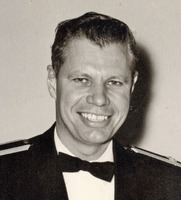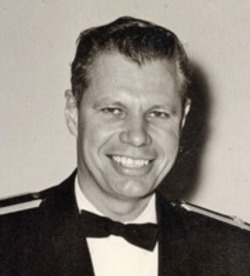

This is a thanksgiving to my Father for all of what he has done. If you can read, hear, or say this, thank your parents. William J. Clem has done, as my Father, more for me than anyone else spritually, educationally, and in love of me. He has given me guidance, attention, food, housing, clothes and school and hobby items for the past 60 years. I most certainly love him very much!!!
By BISHOP ROBERT VASA December 31, 2007
Online Edition –
Vol. VI, No. 8: November 2000
Dress, Demeanor, Discipline
Show how We Value Holy Mass
by Bishop Robert Vasa
Several years ago I had the opportunity, while visiting Washington, DC, to observe the changing of the guard at the Tomb of the Unknown Soldier at Arlington National Cemetery.
I was so struck by the simple, deliberate elegance of the ceremony that I stayed for extra minutes simply to watch the young man march to and fro with that same simple, deliberate elegance. The uniforms were absolutely impeccable, the shoes shined to pure gloss, the faces of the guards set like granite, the measured steps precise, the entire person focused on the job at hand. It was clear from all of the above that the young men knew that what they were about was serious and important.
I have reflected repeatedly on the Arlington experience as it relates to what we do in our Catholic Churches. The Holy Sacrifice of the Mass is the most significant event in the world. As the priest and ministers enter the church and proceed down the aisle, there is not the expectation that they imitate the guards at Arlington, but it would be most appropriate to do so. The guard at Arlington processes solemnly in front of a tomb of national significance, and he is rightfully dignified. Every altar in every Catholic Church has eternal significance and deserves a regard greater than that demanded by the national tomb.
I am not advocating a religious solemnity devoid of joy or humanity, but it appears that Arlington may have something which the Catholic Church needs. The dignity manifested by the guard points towards and accentuates the dignity of the place. Silence is observed at the National Tomb. Silence is a sign of respect for the place and the meaning of the place. Silence is appropriate and enforced vigorously there. Order is enforced there.
As I stood watching the guard making his seemingly routine and non-variable march, he suddenly broke out of line two steps at an angle to his right. He removed the rifle from his shoulder, held it in his hands, and said very forcefully, "Stay behind the barrier!" A couple of seconds later, he repeated the command, at which a woman who had crossed into forbidden territory to get a better picture retreated to the area reserved for visitors. He then returned to his line and resumed his march. No apology, no explanation; the sign said "No Trespassing"; what part of "No" was not understood?
The trespass onto sacred secular soil was deemed unacceptable. The dignity of the place demanded order and an observance of that order. Once again, I do not advocate this kind of rigid, cold enforcement, but the dignity of our churches needs to be fostered and preserved. The dignity of this sacred place will be lost as the sacredness of the area around the tomb would quickly be lost, if there is not a decided effort to preserve it.
Wouldn’t it be cute if four or six little 5-year-olds dressed up like Marines and marched back and forth with the guard? It might be cute, but it would not befit the dignity of the place or the solemnity of the occasion. Yet time and again, we try to introduce people and behaviors into our churches which are deemed "cute" and therefore somehow mandatory. I suggest that "cute" has its place, but Arlington National Cemetery is not one of them, and neither are our churches which house Jesus Himself, Body, Blood, Soul and Divinity.
Several years ago, the Holy Father reinstituted a dress code for the churches of Rome, his diocese. No one in shorts or sleeveless shirts was to be admitted into the church building.
An American sense of rights and freedom rebels against such rules, calling them absurdities. Yet it was done and it was enforced. Tourists who had traveled across an ocean to see a church were turned back at the door unless they were properly attired. This was only to visit a church while no other liturgical action was going on. The Holy Father saw a need to institute a policy aimed at restoring, in a very concrete way, a proper sense of reverence for the house of God.
I have often heard the argument that the administrators of churches should be pleased to see that people come, regardless of how they are dressed. The other side of that is that people need to demonstrate in word and deed the proper disposition and attitude. I am certain the American people would be rightfully chagrined if the guard at the Tomb of the Unknown Soldier were to show up in plaid shorts, a tank top and half-laced tennis shoes. It is hard to imagine that he could have a proper interior attitude to the job at hand were he to come to "work" dressed like that.
Our liturgy is a sacred "work". How we come to that work is probably as important as the fact that we come. We must recognize that we come to church for sacred work, sacred worship. This demands a decorum commensurate with the dignity of the work to be done. Even if that "work" is to utter a private prayer, it still demands an appropriate decorum.
The soldiers at Arlington know the sacredness of the work which they do. Their dress, their demeanor, their discipline all speak of their recognition of that sacredness. Seeing them is a source of pride for me.
I am proud of what they represent, proud of the values which their discipline bespeaks, proud of the country which at heart still knows that honor and fidelity are worth defending.
For these values people live, and for these values people give their lives. The dress and demeanor of these troops says that they truly honor and respect the life and death of those represented at the Tomb of the Unknown.
Catholics likewise need to know the sacredness of the liturgical "work" which they do. Their dress, their demeanor, their discipline, ought all to speak of their recognition of that sacredness.
Seeing the dress and demeanor of Catholics in Church ought to be a source of pride. They ought to manifest a genuine respect for Jesus present, as well as for the values of the Catholic Church. For these values, saints, declared and not declared, gave their lives; for these values each Catholic must be willing to dress in a fashion which shows recognition and respect.
Bishop Vasa, a native of Lincoln, Nebraska, was made bishop of the Diocese of Baker, Oregon, in 1999.
This essay originally appeared in the Catholic Sentinel June 30, 2000. It is reprinted with permission.
*
Catholic Anti-Communism
by Patrick Allitt - April 4, 2009
Reprinted with permission.
Communism was never popular in America, and no American group was more fervently anti-Communist than the Catholics. The American bishops, like the Vatican, had condemned Marxism before 1900 for its atheism, its violation of natural law principles, and its theory of inevitable class conflict. They condemned the Russian Revolution of 1917 that brought Lenin and the Bolsheviks to power. They condemned American Communism in the 1930s for its adherence to the Moscow party line, its frequent about-turns of policy, and its support of the anti-Catholic Republicans in the Spanish Civil War.
Even in the Second World War, when America and the Soviet Union were allies against Nazism, Catholics kept their distance. Archbishop Francis Beckman of Dubuque, for example, warned in 1942 that "the Christ-haters of Moscow and their international brethren… may well take note of the Church Militant when she becomes aroused." And even as victorious American and Soviet troops shook hands at the River Elbe in early 1945, Catholic Mind reminded its readers that although "during the war there has been much wishful thinking about the transformation of the Soviet system… the reality remains unchanged." It added that "the war has given the dictatorship a stronger, more penetrating grip on the country than it ever had before." But it was in the twenty years of the "high" Cold War era, 1945-1965, that Catholic anti-Communism reached its climax, affecting every Catholic at home, at school, at work, in politics, in church, and even in devotional life.
The case against Communism seemed unassailable to American Catholic intellectuals. In 1948 John A. O'Brien, S.J., wrote, "There is no place for any concept of sin and redemption by Christ. Society and man in society are borne along like flotsam and jetsam in the tide without moral responsibility towards a mechanistically predetermined millennium where the state, an instrument of oppression, will wither away and the brotherhood of man will be realized without the fatherhood of God." Communism, agreed Joseph McSorley, C.S.P., in a 1947 article for the Paulist Fathers' journal, The Catholic World, was "utterly inhuman, in its indifference to justice, to mercy, to religion, even to logic." A few years later, National Review editor and Catholic convert Frank Meyer wrote that "Communism, in actual and objective fact, does represent an absolute black, and the West, as a civilization in its essence, as close to an absolute white as is possible in the subdued light which illuminates this imperfect world."
Liberal Catholics shrank from Communism with the same sense of horror as the conservatives. The editors of Commonweal, for example, wrote in 1953 that they were "deeply concerned with genuine measures to fight Communism – moral, economic, military, and psychological." Thomas Merton, the convert, Trappist monk, and hero of the liberal Catholics, preached an unbending anti-Communist message, as did the great Jesuit theologian of the era, John Courtney Murray. Communism, wrote Murray, "came out of the East as a conscious apostasy from the West" and "assumed the task at which Jacobinism failed – that of putting an end to the history of the West." Like his fellow Catholic intellectuals, Murray had no doubt that he was involved in a war for the survival of Western civilization and Christianity.
It was not only intellectuals who refined the anti-Communist argument. Practical politicians, local and national, were equally dedicated to the anti-Communist cause. The most famous was the junior U.S. senator from Wisconsin, Joseph R. McCarthy. Backed by the vice president of Georgetown University, Father Edmund Walsh, McCarthy made a press sensation in 1950 by declaring that he had a list of 205 State Department officials who were Communist Party members and that President Truman had knowingly permitted them to stay in their jobs. Throughout the anxious Korean War years that followed, McCarthy continued to make wild claims of a widespread Communist conspiracy within the federal government, and he won the loyal support of Cardinal Spellman of New York, the Knights of Columbus, the Catholic War Veterans, and other patriotic organizations. Only when he attacked the U.S. Army did he overreach the bounds of most Catholics' credulity.
Other prominent Catholic anti-Communists in public life included Senator Pat McCarran of Nevada, head of the Senate Internal Security Subcommittee, and Thomas Murphy, the prosecutor in the Alger Hiss perjury and espionage trials. Murphy recalled with pride that "I can't recall one Irish name among the many thousands called upon before the House Committee on Un-American Activities." Not all Catholics were red-baiters or McCarthyites, to be sure, but those who opposed McCarthy, such as the editors of America and Commonweal, argued that his scattershot charges of treason were discrediting federal investigation procedures and cloaking the real subversive work of Communist agents. Rallying to McCarthy, a pair of young Catholic intellectuals, William F. Buckley, Jr., and L. Brent Bozell, wrote a defense of his methods, McCarthy and His Enemies (1953). He may be ham-fisted, they said, but at least he takes seriously the apocalyptic threat of communism.
Bishops, priests, and ordinary Catholic citizens joined intellectuals and politicians in the struggle against Communism. Frequent sermons and pastoral letters reminded Catholics of the evil they faced in the great world standoff of the Cold War, and most of them supported the American policy switch to a defense based on nuclear deterrence. Cardinal Francis Spellman of New York took second place to no one in his anti-Communist fervor, and he began to interpret any sign of opposition to his will as a sign of Communist subversion. In 1949 he even tried to discredit striking Catholic gravediggers in his diocese by making the outrageous claim that they were Communists. (The ploy backfired because their union was militantly anti-Communist. Some of the cemetery workers had been in fistfights with pro-Communist unionists in defense of the Church.) Archbishop Richard Cushing of Boston hired a personal "expert" to advise him on Communism between 1959 and 1963. His choice was Louis Budenz, a former Communist who had converted to Catholicism in 1946 and become an informer to government investigators against his old party comrades.
As Catholics moved out of the urban immigrant ghettoes and into the rising suburbs in the 1940s and 1950s, tens of thousands of them bought televisions, the era's great new technology. Many of them had been listening to the radio for twenty years or more and could remember the staunchly anti-Communist Detroit priest Father Charles Coughlin from the 1930s. Now, in Monsignor Fulton Sheen (bishop from 1951), they had their first television star with his popular weekly show Life is Worth Living. Sheen could hold his own against rival media gurus of the moment like Norman Vincent Peale. His Peace of Soul (1954) was a best-seller. But Sheen was as zealous against Communism as his boss, Spellman, and he too favored vigorous measures to root out pro-Communist sympathizers from the government and from American colleges. In one broadcast he declared:
Communism is the social body what leprosy is to the physical body; in fact it is more serious, for Communism affects personality directly, while disease affects the mind and soul only indirectly. In moral language, Communism is intrinsically evil. It is evil because it submerges and destroys personality to the status of an ant in an anthill; free government is made impossible through its basic principle enunciated by Engels, that freedom is necessity or obedience to a dictator.
His book Communism and the Conscience of the West (1948) was a protracted warning against the Soviet parody-religion of Communism, which reminded Catholics that they would have to muster a zeal equal to the Communists' own in fighting back against them.
Even devotional life was affected by anti-Communism, as the Catholic historians Thomas Kselman and Steven Avella have shown. An apparition of the Blessed Virgin Mary to a group of children at Fatima, Portugal, in 1917, had inaugurated the Virgin's own war against Communism. According to the Catholic Mirror of 1948 she had told the children, "If my requests are heard, and the world is consecrated to my Immaculate Heart, Russia will be converted and the world will have peace," but "if my requests are not heard, the evil doctrines of atheistic Russia will spread over the whole world." Members of the "Blue Army," founded in America in 1950, honored the Fatima visionaries and circulated Soul magazine to 70,000 anti-Communist enthusiasts. A Wisconsin housewife, Mrs. Mary Ann Van Hoof, also beheld the Virgin in 1950. The Virgin told Mrs. Van Hoof and the crowds who began to gather on her farm that the Korean War, then in its early days, was the beginning of the end unless American Catholics rededicated themselves to prayer and piety.
Underlining fears of a Communist "Fifth Column" in the nation, the Virgin also disclosed that "the Enemy of God is all over America. You'd be surprised if the sheep's clothing were taken off – and how they'd spring up around you." She added that "the black clouds are coming" and that "Alaska is the first stepping stone," more ominous warnings to a nation afraid of Soviet invasion. Novenas to pray for the conversion of the Russians were common in urban dioceses, organized by the Blue Army, the Knights of the Immaculata, and other devotional groups.
Catholic newspapers and magazines kept the anti-Communist fires burning brightly by bringing news of fresh persecutions into every Catholic home. Soviet conquests in Eastern Europe meant that the large Catholic populations of Poland, Hungary, and Czechoslovakia – and several senior churchmen, including Archbishop Stepinac in Yugoslavia – lived "in chains" behind the Iron Curtain. The most dramatic incident was the Hungarian Revolution of 1956, when a combination of workers and students, many of them Catholics, overthrew the puppet Soviet regime in Budapest and set free the prince-primate of their Church, Cardinal Joszef Mindszenty, who made a triumphant entry into the city. He was not at liberty for long because a Soviet counterattack rolled into Budapest and crushed the uprising. Mindszenty, in fear for his life, sought sanctuary at the American embassy. A diplomatic stand-off followed, leaving Mindszenty stranded there for the next eighteen years. The Soviets would not promise him safe conduct out of the country while the Americans would not hand him over to his tormentors. He became a living example of the Catholic refusal to compromise with Communism. American Catholics lionized him for this show of unflagging determination. Hungarian refugees to America spread word of his example and helped form "Mindszenty societies," Catholic groups to study Communist techniques. A Catholic church in New Brunswick, New Jersey even erected a statue of Mindszenty.
China as well as Russia became a source of acute anxiety in the early Cold War years. In 1947 the Catholic archbishop of Nanking, Paul Yu-Pin, told an audience in Washington that although the fighting between Mao Zedong and Chiang Kai Shek had "the appearance of a civil war," it was really "the beginning of an international war, a world war, launched by the Soviet Union against the democracies." The victory of Mao's "Red" Chinese in 1949 horrified a generation of American idealists, missionaries, and policy makers, who found it difficult to believe, then or later, that this was more a domestic revolution than a Soviet conquest.
A steady stream of atrocities, with missionaries or Chinese Catholics as the hapless victims, sustained American Catholics' apostolic indignation through the 1950s and early 1960s. More volatile was Vietnam, where even American help could not prevent the collapse of the old French colonial empire in 1953 to a Communist attack. Catholic anti-Communists could take comfort from the brave work of Dr. Tom Dooley in Vietnam and neighboring Laos. Dooley, a St. Louis-born navy doctor, supervised the evacuation of Catholic refugees from northern to southern Vietnam in 1955 and wrote a moving book about the experience, Deliver Us From Evil, which became a Catholic best-seller. Later he wrote sequels, describing the simple medical centers he built to bring basic health care to neglected Laotions. His self-image, as historian James Fisher shows in a new biography, was that of a man advancing the anti-Communist cause with a stethoscope in one hand and a crucifix in the other. This work was a public relations bonanza for the American government and the Catholic church, made all the more poignant by the fact that Dooley died young, only thirty-four years of age. He became almost a saintly figure to a generation of young Catholics. Like Mindszenty he embodied American Catholic Anti-Communism at its most heroic and high-minded.
Ironically, few Americans had practical opportunities to act on their deeply held anti-Communist convictions. As the Hungarian Revolution had shown, President Eisenhower did not dare to intervene on behalf of anti-Communist rebels behind the Iron Curtain. America's nuclear arsenal was already big enough to pulverize the Soviet Union but Russia had nuclear bombs too, which induced a strategic deadlock. For forty-four years the face-off continued, with each side frozen in place, blending overwhelming firepower with effective powerlessness. In retrospect it is clear that much of the energy diverted into seeking domestic Communists was ill spent. American Communist Party members and ex-members certainly existed, but not in large enough numbers or with enough unity to make a credible threat to national security. Meanwhile, Catholics' zeal to stamp out domestic Communism gave them a reputation among other population groups of abusing constitutional rights and favoring an oppressive state bureaucracy. The unkindest cut came from Paul Blanshard, an anti-Catholic polemicist, whose Communism, Democracy, and Catholic Power (1951) drew readers' attention to the "deadly parallels" between Catholicism and Communism. They were, he said, twin tyrannical systems threatening American democratic freedoms.
But while Catholics' outspoken anti-Communism gave them bad publicity among civil libertarians, it won them the applause of "law and order" organizations, such as the untiring FBI under J. Edgar Hoover, who recruited heavily among Catholics. Anti-Communism was a good symbolic issue for Catholic immigrants and their children, too. They could allay nativist fears about divided loyalties by pointing to their anti-Communist ardor as evidence of "one hundred percent Americanism."
The broad anti-Communist consensus among American Catholics broke down as Vatican II ended in 1965. Pope John XXIII's peace encyclical, Pacem in Terris (1963), took some of the crusading wind out of anti-Communist sails, and Paul VI tried to make diplomatic contact with the Soviet Union. At home Catholics began to divide over other issues. First the civil rights movement caused a sharp difference of opinion. Catholic conservatives argued that activists like Martin Luther King, Jr., were Communist dupes. Catholic liberals like the Jesuit priest John Lafarge countered that King was a "prophetic" religious figure whose acts of witness ought to awaken Catholic consciences too long asleep. Then the Vietnam War tore apart the Catholic anti-Communist consensus. Cardinal Spellman, unshaken in his old beliefs, went to Vietnam to pray with the troops at Christmas in 1966, but by then the outspoken "Catholic left," led by the Berrigan brothers, priests with a talent for theatrical gestures, was arguing that an obsession with Communism had blinded American Catholics to issues of social justice, peace, and freedom. America, in this telling, was the enemy of freedom, rather than its last bastion.
The "culture wars" of the 1970s and 1980s contributed to the fragmentation of American Catholic culture, which enjoyed little of the certitude that had held it together in the 1950s. Marxist Communism as an atheist ideology had lost virtually all its radiance by the mid 1970s though it began to show up in religious dress, much modified, in elements of liberation theology. Still, the old anti-Communist verities lived on in the mind of Pope John Paul II. Annealed to political-religious struggle in Cold War Poland, he recognized no essential change in the situation, however much his American flock might be experiencing second thoughts. The events of 1989 vindicated him, enabling Catholic anti-Communists everywhere to rejoice. Their own view of the world had prevailed while its greatest rival of the century had degenerated and then died.
Patrick N. Allitt is Goodrich C. White Professor of History at Emory University.
Woman - My Confession
FREE 100-Page Book!
The Marianne Collins Story
Get the CatholiCity Message
you@example.com
© 1996-2018 The Mary Foundation · 501(c)3
As our family were Roman Catholics that usually attended Holy Mass, the last time I attended Holy Mass with my Father William was on December 24, 2014 at 11:20 p.m. at Saint Barbara Roman catholic Mission Church in Santa Barbara, California where I attended with my only brother William and my sister Patricia. We met other Roman Catholics in Christian fellowship and sharing with our family
V. Let us pray for N., the Pope.
R. May the Lord preserve him, give him a long life, make him blessed upon the earth, and may the Lord not hand him over to the power of his enemies.
V. May your hand be upon your holy servant.
R. And upon your son whom you have anointed.
Let us pray. O God, the Pastor and Ruler of all the faithful, look down, in your mercy, upon your servant, N., whom you have appointed to preside over your Church; and grant, we beseech you, that both by word and example, he may edify all those under his charge; so that, with the flock entrusted to him, he may arrive at length unto life everlasting. Through Christ our Lord. R. Amen.
Prayer to End Abortion
Lord God, I thank you today for the gift of my life,
And for the lives of all my brothers and sisters.
I know there is nothing that destroys more life than abortion,
Yet I rejoice that you have conquered death
by the Resurrection of Your Son.
I am ready to do my part in ending abortion.
Today I commit myself
Never to be silent,
Never to be passive,
Never to be forgetful of the unborn.
I commit myself to be active in the pro-life movement,
And never to stop defending life
Until all my brothers and sisters are protected,
And our nation once again becomes
A nation with liberty and justice
Not just for some, but for all.
Through Christ our Lord. Amen!
HOME - PRAYER REQUESTS - QUESTIONS & COMMENTS
Priests for Life
PO Box 236695 • Cocoa, FL 32923
Tel. 321-500-1000, Toll Free 888-735-3448 •
mail@priestsforlife.org
NOVENA PRAYER
FOR CONVERSION FROM CONTRACEPTION
(By Rev. Thomas J. Euteneueu.)
[A novena of conversion for those who use or promote contraception.]
Heavenly Father,
“from whom every family in heaven and on earth takes its name,” (Eph 3:15)
grant conversion of heart to our world,
our society, our families
and especially to our own hearts regarding the sin of contraception.
We believe, beyond a doubt,
what the one, holy, Catholic and apostolic Church
teaches about this moral evil,
and we wish to be a light to the nations
to make the truth known wherever this evil practice and ideology has taken root.
Call us to be faithful to your command to “Be fruitful and multiply!”
so that we may advance the civilization of life and love
that you wish to create for the human family.
Bring to conversion those who, in public or private,
lead others into the sin of contraception
and who erroneously teach that it prevents abortion.
Help us all to be purified of the lies and distortions
of the culture of death by obedience to the truth
and bring us all to the fullness of truth
through the guidance of your Church.
We ask this through the intercession of the Immaculate Virgin Mary,
in whose fertile womb your Blessed Son found his home on earth.
Amen.
Prayer to Our Lady of Fatima against Communism
O Queen of Fatima, in this hour of so many dangers for the Americas and the world, turn away from us the scourge of atheistic communism. Do not allow communist regimes, which deny all the Commandments of God, to be established in the many countries born and formed under the sacred influence of Christian civilization. Therefore, O Lady, nourish and intensify the rejection which communism encounters at all levels of society in the Americas.
Help us always remember that:
1. The Decalogue commands us, “Thou shalt love the Lord thy God with thy whole heart,” “Thou shalt not take the name of the Lord thy God in vain,” and “Thou shalt keep holy the Sabbath day”; whereas atheistic communism does everything to extinguish the Faith, to lead men to blasphemy, and to create obstacles to the normal and peaceful celebration of worship;
2. The Decalogue commands us, “Thou shalt honor thy father and thy mother,” “Thou shalt not commit adultery,” and “Thou shalt not covet thy neighbor’s wife.” Now communism strives to break the ties between parents and children, turning their education over to the State. Communism denies the value of virginity and teaches that marriage can be dissolved for any reason, at the mere wish of one of the spouses.
3. The Decalogue commands us, “Thou shalt not steal,” and “Thou shalt not covet thy neighbor’s goods.” Communism denies private property and its very important social function;
4. The Decalogue commands us to “not kill.” Communism employs wars of conquest as a means of ideological expansion and promotes revolutions and crimes all over the world;
5. The Decalogue commands us to “not bear false witness,” whereas communism systematically uses lies as weapons of propaganda.
Intervene so that all the peoples of the Americas, resolutely hindering the steps of communist infiltration, may help bring closer the glorious day of victory which Thou didst predict at Fatima with these words so filled with hope and sweetness:
Finally, my Immaculate Heart will triumph.
William, my Father, frequently ordered me to attend Roman Catholic Mass on most Sundays. At Mass, he ordered me not to touch the Eucharist Communion host as he said it was Sacrilege and blasphermy and not to ask questions of the priests who were celebrating and leading the Roman catholic Mass.
William, as a Roman Catholic Father and layman received five of the seven sacraments of the Church in his life. They were Baptism, First Communion, Confession, Confirmation, and Holy Matrimony. As a Catholic layman, he never received the sacrament of Holy orders. Shorty before he died, William, my Father, should have been given the Sacrament of extreme unction by Bishop Robert Vasa.
William, as my Father, went to Vietnam for 2 weeks in 1969 during the Vietnam War to help win that war and have the USA take over Southeast Asia to keep it free as he really served there. many Americans and other people around the world opposed that war then, but I really supported my Father's effort to win that war and fight for the United States of America & then I supported that war.
As a real Roman Catholic layman who had 8 children, William, my Father, worked with and supported Human Life International and Father Paul Marx, its leader, in the 1980's and 1990's when it was headquartered only a few miles from his home back then in nearby Gaithersburg, Maryland to stop abortion and birth control and help made the USA the third most populated nation on earth.
My father, William, was very anti-communist from when he was 6 years old and has signed loyalty oaths for the government of the United States of America's existence and to fight against and oppose Communism always. because of this, my father William was given a Top Secret Security Military clearance by the US Department of Defense in the 1940's & it ended in when he retired the 1980's